# LangChain 基于 Runnable 封装记忆链:从手写自动管理到新版生产实践
记忆链的本质并不复杂:模型调用前,把历史消息加载进 prompt;模型调用后,把本轮用户输入和模型输出保存回记忆系统。
如果把它拆成执行流程,就是两步:
- 调用前:
load_memory_variables(input),得到history。 - 调用后:
save_context(inputs, outputs),保存本轮对话。
Runnable 的组合能力足够灵活,所以可以自己把这两步封装进 LCEL 链里。常见做法是:用 RunnablePassthrough.assign() 在链前面注入历史,用 with_listeners(on_end=...) 在链结束后保存上下文。
这篇文章就从这个手写封装讲起,但重点不是鼓励生产里重复造轮子,而是看清它背后的机制,以及为什么现在更推荐 RunnableWithMessageHistory 或 LangGraph checkpointer。
# 记忆链的运行流程
一个自动管理记忆的 Runnable 链,大概长这样:
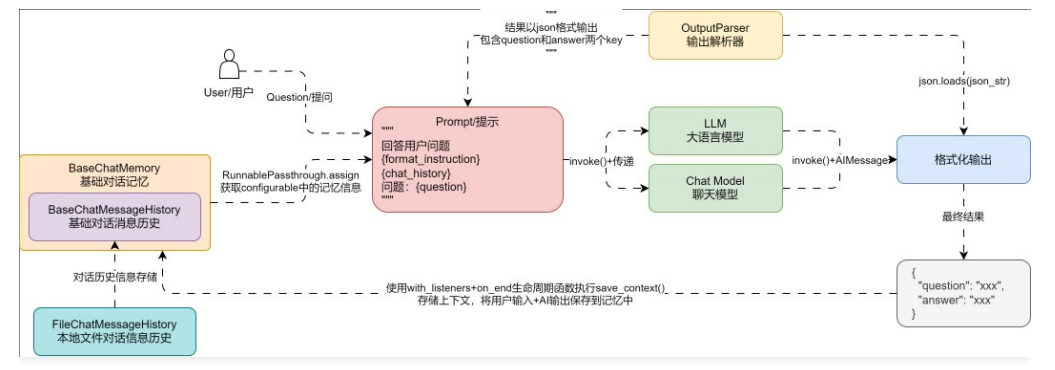
可以把它理解成一条带前置读取和后置写入的链:
- 用户传入当前问题。
- 链从运行配置里找到对应的 memory。
- 调用 memory 加载历史消息。
- 把历史消息注入 prompt。
- 调用模型生成回答。
- 解析输出。
- 在生命周期结束时保存本轮输入和输出。
用 LCEL 写出来,大概是:
from operator import itemgetter
from typing import Any

from langchain_core.output_parsers import StrOutputParser
from langchain_core.prompts import ChatPromptTemplate
from langchain_core.runnables import RunnableConfig, RunnableLambda, RunnablePassthrough
from langchain_core.tracers.schemas import Run


def load_history(input: dict[str, Any], config: RunnableConfig) -> list:
    memory = config.get("configurable", {}).get("memory")
    if memory is None:
        return []
    variables = memory.load_memory_variables(input)
    return variables.get("history", [])


def save_history(run: Run, config: RunnableConfig) -> None:
    memory = config.get("configurable", {}).get("memory")
    if memory is None:
        return
    memory.save_context(run.inputs, run.outputs)


prompt = ChatPromptTemplate.from_messages(
    [
        ("system", "你是一个可靠的业务助手。"),
        ("placeholder", "{history}"),
        ("human", "{query}"),
    ]
)

chain = (
    RunnablePassthrough.assign(
        history=RunnableLambda(load_history)
    )
    | prompt
    | llm
    | StrOutputParser()
).with_listeners(on_end=save_history)

answer = chain.invoke(
    {"query": "我刚才说我的项目叫什么?"},
    config={"configurable": {"memory": memory}},
)
2
3
4
5
6
7
8
9
10
11
12
13
14
15
16
17
18
19
20
21
22
23
24
25
26
27
28
29
30
31
32
33
34
35
36
37
38
39
40
41
42
43
44
45
这个写法能工作,也很适合理解 Runnable 的机制:config["configurable"] 可以传运行时对象,RunnableLambda 可以读配置,with_listeners() 可以在结束时拿到 run 输入输出。
但它也有不少生产问题。
# 这个手写方案的核心机制
手写记忆链靠三个 Runnable 能力拼出来。
第一是 RunnableConfig.configurable。它把本次运行需要的记忆对象传进链:
config={
    "configurable": {
        "memory": memory,
    }
}
2
3
4
5
第二是 RunnablePassthrough.assign()。它保留原始输入,同时追加一个 history 字段:
RunnablePassthrough.assign(
    history=RunnableLambda(load_history)
)
2
3
输入:
{"query": "继续解释"}
会变成:
{
    "query": "继续解释",
    "history": [...],
}
2
3
4
第三是 with_listeners(on_end=...)。模型和 parser 执行完成后,监听器拿到 Run 对象,再把输入输出保存到 memory。
这就是“记忆自动管理”的来源:业务层只调用 chain.invoke(),读取和保存都包在链里。
# 为什么这不是当前首选
这个方案的问题不在于不能用,而在于边界太容易失控。
第一,configurable 里直接塞 memory 实例,会让配置变成对象传递通道。生产系统里,config 更适合传 session_id、thread_id、tenant_id 这类稳定标识,由服务端工厂函数查出对应的历史对象。
第二,on_end 依赖最终输出格式。如果链输出字符串、字典、AIMessage、结构化对象,save_context() 的处理逻辑都不一样。稍微换一个 parser,保存逻辑就可能坏。
第三,错误场景不好处理。模型成功但保存失败怎么办?保存成功但响应返回失败怎么办?重试后会不会重复保存?流式输出中途失败时要不要保存半截结果?
第四,并发和幂等要自己处理。同一个 session 的多次请求同时进来,历史顺序可能错乱;请求重试后可能重复写入。
第五,旧式 BaseMemory 抽象已经不是新项目的首选。现在更推荐基于消息历史、checkpointer 和 store 来管理状态。
所以,这个方案适合作为理解 Runnable 的练习,也适合非常小的原型。生产项目应该优先使用更明确的记忆封装。
# 当前推荐:RunnableWithMessageHistory
对于普通 LCEL 聊天链,当前更推荐 RunnableWithMessageHistory。它就是专门为“包装一个 Runnable,并自动读取和更新聊天历史”设计的。
典型写法:
from langchain_core.chat_history import BaseChatMessageHistory
from langchain_core.messages import BaseMessage
from langchain_core.prompts import ChatPromptTemplate, MessagesPlaceholder
from langchain_core.runnables.history import RunnableWithMessageHistory
from pydantic import BaseModel, Field


class InMemoryHistory(BaseChatMessageHistory, BaseModel):
    messages: list[BaseMessage] = Field(default_factory=list)

    def add_messages(self, messages: list[BaseMessage]) -> None:
        self.messages.extend(messages)

    def clear(self) -> None:
        self.messages = []


store: dict[str, InMemoryHistory] = {}


def get_session_history(session_id: str) -> BaseChatMessageHistory:
    if session_id not in store:
        store[session_id] = InMemoryHistory()
    return store[session_id]


prompt = ChatPromptTemplate.from_messages(
    [
        ("system", "你是一个可靠的业务助手。"),
        MessagesPlaceholder(variable_name="history"),
        ("human", "{question}"),
    ]
)

chain = prompt | llm

chain_with_history = RunnableWithMessageHistory(
    chain,
    get_session_history,
    input_messages_key="question",
    history_messages_key="history",
)

response = chain_with_history.invoke(
    {"question": "我叫小林"},
    config={"configurable": {"session_id": "thread_001"}},
)
2
3
4
5
6
7
8
9
10
11
12
13
14
15
16
17
18
19
20
21
22
23
24
25
26
27
28
29
30
31
32
33
34
35
36
37
38
39
40
41
42
43
44
45
46
47
第二次调用同一个 session_id:
response = chain_with_history.invoke(
    {"question": "我叫什么?"},
    config={"configurable": {"session_id": "thread_001"}},
)
2
3
4
它会自动把历史消息注入 history,并在调用后写回消息历史。
这比手写 assign + with_listeners 更清晰,因为它把输入消息字段、历史字段、输出消息字段都显式建模了。
# 多租户生产写法
生产里一般不会只靠一个 session_id。更常见的是用租户、账号、会话三类信息定位历史:
from langchain_core.runnables import ConfigurableFieldSpec


def get_session_history(
    *,
    tenant_id: str,
    actor_hash: str,
    thread_id: str,
) -> BaseChatMessageHistory:
    return history_repository.get_or_create(
        tenant_id=tenant_id,
        actor_hash=actor_hash,
        thread_id=thread_id,
    )


chain_with_history = RunnableWithMessageHistory(
    chain,
    get_session_history=get_session_history,
    input_messages_key="question",
    history_messages_key="history",
    history_factory_config=[
        ConfigurableFieldSpec(
            id="tenant_id",
            annotation=str,
            name="租户 ID",
            description="用于隔离不同租户的聊天历史",
            default="",
            is_shared=True,
        ),
        ConfigurableFieldSpec(
            id="actor_hash",
            annotation=str,
            name="用户哈希",
            description="脱敏后的用户标识",
            default="",
            is_shared=True,
        ),
        ConfigurableFieldSpec(
            id="thread_id",
            annotation=str,
            name="会话 ID",
            description="一次连续对话的线程标识",
            default="",
            is_shared=True,
        ),
    ],
)
2
3
4
5
6
7
8
9
10
11
12
13
14
15
16
17
18
19
20
21
22
23
24
25
26
27
28
29
30
31
32
33
34
35
36
37
38
39
40
41
42
43
44
45
46
47
48
调用时:
response = chain_with_history.invoke(
    {"question": "继续刚才的方案"},
    config={
        "configurable": {
            "tenant_id": "tenant_a",
            "actor_hash": "usr_8f4a",
            "thread_id": "thread_001",
        }
    },
)
2
3
4
5
6
7
8
9
10
这比传 memory 对象更适合生产:
- 配置里是稳定标识,不是可变对象。
- 历史仓储由服务端统一管理。
- 可以做租户隔离。
- 可以做权限校验。
- 可以接 Redis、Postgres、MongoDB 等持久化。
- 可以统一加锁、去重、审计和过期策略。
# 持久化不要用内存
示例里的 InMemoryHistory 只适合开发和测试。生产环境至少要解决这些问题:
- 服务重启后历史不能丢。
- 多实例部署时历史要共享。
- 同一个 thread 的并发写入要有顺序。
- 历史要支持 TTL 和清理。
- 敏感内容要加密或脱敏。
- 删除历史要符合用户隐私要求。
- 历史写入失败要能重试或补偿。
可以把 BaseChatMessageHistory 接到自己的仓储层:
class PostgresChatMessageHistory(BaseChatMessageHistory):
    def __init__(self, repository, tenant_id: str, thread_id: str):
        self.repository = repository
        self.tenant_id = tenant_id
        self.thread_id = thread_id

    @property
    def messages(self) -> list[BaseMessage]:
        return self.repository.list_messages(
            tenant_id=self.tenant_id,
            thread_id=self.thread_id,
        )

    def add_messages(self, messages: list[BaseMessage]) -> None:
        self.repository.append_messages(
            tenant_id=self.tenant_id,
            thread_id=self.thread_id,
            messages=messages,
        )

    def clear(self) -> None:
        self.repository.clear_messages(
            tenant_id=self.tenant_id,
            thread_id=self.thread_id,
        )
2
3
4
5
6
7
8
9
10
11
12
13
14
15
16
17
18
19
20
21
22
23
24
25
注意优先实现 add_messages(),而不是每条消息单独 add_message()。这样可以减少数据库往返,也更容易做事务。
# Agent 场景:优先 checkpointer
如果是 Agent,不建议手写 RunnableWithMessageHistory 去包每一步。当前 LangChain Agent 的短期记忆更推荐交给 LangGraph checkpointer。
官方思路是:Agent 的短期记忆属于图状态,状态通过 checkpointer 按 thread 持久化。每次调用时传入 thread_id:
from langchain.agents import create_agent
from langgraph.checkpoint.memory import InMemorySaver


agent = create_agent(
    model="openai:gpt-5.5",
    tools=[get_user_info],
    checkpointer=InMemorySaver(),
)

config = {"configurable": {"thread_id": "thread_001"}}

agent.invoke(
    {"messages": [{"role": "user", "content": "我叫小林"}]},
    config,
)

agent.invoke(
    {"messages": [{"role": "user", "content": "我叫什么?"}]},
    config,
)
2
3
4
5
6
7
8
9
10
11
12
13
14
15
16
17
18
19
20
21
这种方式更适合 Agent,因为 Agent 的状态不只有聊天历史,还可能包含:
- 工具调用过程。
- 中间推理步骤。
- 文件状态。
- 用户偏好。
- 子任务状态。
- 可恢复的执行快照。
手写 memory 链很难覆盖这些状态管理需求。
# 流式输出怎么处理
手写 on_end 保存上下文有一个隐藏问题:流式输出。
如果使用 stream() 或 astream(),模型输出可能是一段一段产生的。你要决定:
- 是等完整输出结束后保存。
- 还是边生成边缓存。
- 如果中途异常,是否保存部分输出。
- 用户取消请求时,是否保存。
- 输出被内容安全拦截时,是否保存。
RunnableWithMessageHistory 已经处理了常见消息输入输出场景,但复杂流式产品仍然建议在服务层维护一个响应缓冲区。只有当输出完整、通过安全检查、成功返回给用户后,再写入历史。
生产里不要把“模型生成了”直接等同于“用户看到了”。记忆应该记录用户实际经历过的对话。
# 上下文窗口管理
记忆不是把所有历史无限塞回 prompt。上下文窗口、成本和噪声都会限制历史长度。
常见策略包括:
- 只保留最近 N 轮。
- 按 token 数裁剪。
- 摘要旧消息。
- 删除无效消息。
- 对工具消息做压缩。
- 对长文档只存引用,不存全文。
Agent 场景可以使用 LangChain 的 summarization middleware,在接近 token 阈值时自动总结旧消息。普通 LCEL 链也可以在 get_session_history() 或 prompt 之前增加裁剪逻辑。
真正的生产记忆系统,重点不是“能保存”,而是“保存什么、召回什么、何时压缩、何时删除”。
# 什么时候还会手写封装
虽然新项目不建议把手写封装作为默认方案,但它仍然有价值。
适合手写的场景:
- 掌握 Runnable 的配置传递和生命周期。
- 做一个非常小的内部工具。
- 需要兼容已有
BaseMemory抽象。 - 需要在某个非聊天 Runnable 前后读写业务状态。
- 需要临时验证某种记忆策略。
不适合手写的场景:
- 多租户聊天产品。
- 多实例部署。
- Agent 复杂状态。
- 需要流式输出可靠保存。
- 需要严格审计和隐私删除。
- 需要长期维护的生产系统。
手写封装可以帮助理解,但不要让它变成生产架构的地基。
# 问题
手写 Runnable 记忆链最主要的问题,是把太多职责塞进链里。
读取历史、格式化 prompt、调用模型、解析输出、保存上下文、处理错误、处理并发、处理流式、处理持久化,这些职责如果都散在 LCEL 表达式和监听器里,很快会变得难以测试和维护。
另外,with_listeners(on_end=...) 的保存时机也容易误导。on_end 只能说明 Runnable 正常结束,不一定说明响应已经安全地交付给用户。生产里还要考虑网关超时、用户取消、内容安全、保存失败和重复请求。
# 拓展
这个思路可以拓展到更通用的“状态链”:
- 调用前读取用户画像。
- 调用前读取权限上下文。
- 调用前读取实验配置。
- 调用后记录审计日志。
- 调用后更新任务状态。
- 调用后保存模型输出摘要。
但只要状态开始变复杂,就应该抽出状态管理层,而不是一直往 Runnable 监听器里塞逻辑。
更好的方向是:
- 简单聊天链:
RunnableWithMessageHistory。 - Agent 短期记忆:LangGraph checkpointer。
- 长期记忆:LangGraph Store 或业务知识库。
- 观测和审计:callbacks / LangSmith / 日志平台。
- 自定义状态:明确的 repository 和 service 层。
# 实际生产是否使用
生产里不太建议直接使用“把 memory 实例放进 configurable,再用 on_end 保存”的手写方案。
生产里更常见的是:
- 用
RunnableWithMessageHistory管普通 LCEL 聊天历史。 - 用 Redis/Postgres/MongoDB 等持久化
BaseChatMessageHistory。 - 用 LangGraph checkpointer 管 Agent thread 状态。
- 用 Store 或向量库管理跨会话长期记忆。
- 在服务层做会话权限、历史裁剪、摘要和审计。
手写方案可以保留在掌握、原型、兼容旧代码和少数特殊 Runnable 状态管理场景里。
# 现在是否抛弃
要分开看。
Runnable 组合、RunnablePassthrough.assign()、RunnableLambda、with_listeners() 都没有被抛弃,它们仍然是当前 Runnable 体系里的能力。
但是,用旧式 BaseMemory 加手写监听器来封装聊天记忆,已经不是新项目首选。现在更推荐 RunnableWithMessageHistory,而 Agent 场景更推荐 checkpointer。旧方案可以理解机制,也可以维护存量项目,但新项目不应该优先照搬。
# 最新生产如何实现
最新生产实现建议按场景选型。
普通 LCEL 聊天链:
chain_with_history = RunnableWithMessageHistory(
    chain,
    get_session_history=get_session_history,
    input_messages_key="question",
    history_messages_key="history",
)

response = chain_with_history.invoke(
    {"question": question},
    config={
        "configurable": {
            "tenant_id": tenant_id,
            "actor_hash": actor_hash,
            "thread_id": thread_id,
        }
    },
)
2
3
4
5
6
7
8
9
10
11
12
13
14
15
16
17
Agent 短期记忆:
agent = create_agent(
    model=model,
    tools=tools,
    checkpointer=checkpointer,
)

agent.invoke(
    {"messages": [{"role": "user", "content": question}]},
    {"configurable": {"thread_id": thread_id}},
)
2
3
4
5
6
7
8
9
10
长期记忆:
memory = store.search(
    namespace=("tenant", tenant_id, "profile"),
    query=question,
)
2
3
4
生产治理:
- 历史按租户和 thread 隔离。
- 写入使用幂等键。
- 持久化层支持事务或乐观锁。
- 输入输出默认脱敏。
- 历史有 TTL、删除和导出能力。
- 长对话有裁剪和摘要策略。
- trace 记录
thread_id,但不记录完整敏感内容。
最终原则是:Runnable 负责组合,MessageHistory 负责聊天历史,checkpointer 负责 Agent 状态,Store 负责长期记忆,业务服务层负责权限、持久化和治理。这样记忆自动管理才不会从一个方便的小封装,长成后期难以维护的隐性状态系统。