# ReactChildren
ReactChildren 对外暴露了以下 几个方法
export {
  forEachChildren as forEach,
  mapChildren as map,
  countChildren as count,
  onlyChild as only,
  toArray,
};
2
3
4
5
6
7
我们就拿 mapChildren 简单做下分析看看,首先方法如下:
# mapChildren
function mapChildren(children, func, context) {
  if (children == null) {
    return children;
  }
  const result = [];
  mapIntoWithKeyPrefixInternal(children, result, null, func, context);
  return result;
}
2
3
4
5
6
7
8
接下来 来看 mapIntoWithKeyPrefixInternal
function mapIntoWithKeyPrefixInternal(children, array, prefix, func, context) {
  let escapedPrefix = "";
  if (prefix != null) {
    escapedPrefix = escapeUserProvidedKey(prefix) + "/";
  }
  const traverseContext = getPooledTraverseContext(
    array,
    escapedPrefix,
    func,
    context,
  );
  // 将嵌套的数组展平
  traverseAllChildren(children, mapSingleChildIntoContext, traverseContext);
  releaseTraverseContext(traverseContext);
}
2
3
4
5
6
7
8
9
10
11
12
13
14
15
getPooledTraverseContext
const POOL_SIZE = 10;
const traverseContextPool = [];
// 维护一个对象最大为10的池子,从这个池子取到对象去赋值,用完了清空, 防止内存抖动
// 可以循环使用,创建太多的话,也会占据内存
function getPooledTraverseContext(
  mapResult,
  keyPrefix,
  mapFunction,
  mapContext,
) {
  if (traverseContextPool.length) {
    const traverseContext = traverseContextPool.pop();
    traverseContext.result = mapResult;
    traverseContext.keyPrefix = keyPrefix;
    traverseContext.func = mapFunction;
    traverseContext.context = mapContext;
    traverseContext.count = 0;
    return traverseContext;
  } else {
    return {
      result: mapResult,
      keyPrefix: keyPrefix,
      func: mapFunction,
      context: mapContext,
      count: 0,
    };
  }
}
2
3
4
5
6
7
8
9
10
11
12
13
14
15
16
17
18
19
20
21
22
23
24
25
26
27
28
getPooledTraverseContext 就是从 pool 里面找一个对象,releaseTraverseContext 会把当前的 context 对象清空然后放回到 pool 中。
releaseTraverseContext
function releaseTraverseContext(traverseContext) {
  if (traverseContextPool.length < POOL_SIZE) {
    traverseContextPool.push(traverseContext);
  }
}
2
3
4
5
releaseTraverseContext 的作用就是会把当前的 context 对象清空然后放回到 pool 中。
从这两个方法来看感觉 traverseContextPool 永远都是只有一个值,因为每次都是先 pop 完再 push 进去,那么为什么还要 定义POOL_SIZE 为 10呢
那让我们来看看 traverseAllChildren
function traverseAllChildren(children, callback, traverseContext) {
  if (children == null) {
    return 0;
  }

  return traverseAllChildrenImpl(children, "", callback, traverseContext);
}
2
3
4
5
6
7
traverseAllChildren 就做了一次简单判断,然后就去调用自己的实现方法(不知道代码是不是后台老哥写的 😭),traverseAllChildrenImpl 就流程就比较长一点了
function traverseAllChildrenImpl(
  children,
  nameSoFar,
  callback,
  traverseContext,
) {
  const type = typeof children;

  if (type === "undefined" || type === "boolean") {
    // All of the above are perceived as null.
    children = null;
  }
  // invokeCallback=true,才触发callBack执行
  let invokeCallback = false;

  if (children === null) {
    invokeCallback = true;
  } else {
    switch (type) {
      case "string":
      case "number":
        invokeCallback = true;
        break;
      case "object":
        switch (children.$$typeof) {
          //如果props.children是单个ReactElement/PortalElement的话 必会触发invokeCallback=true
          case REACT_ELEMENT_TYPE:
          case REACT_PORTAL_TYPE:
            invokeCallback = true;
        }
    }
  }
  // 处理非数组的情况
  if (invokeCallback) {
    callback(
      traverseContext,
      children,
      // If it's the only child, treat the name as if it was wrapped in an array
      // so that it's consistent if the number of children grows.
      nameSoFar === "" ? SEPARATOR + getComponentKey(children, 0) : nameSoFar,
    );
    return 1;
  }

  let child;
  let nextName;
  let subtreeCount = 0; // Count of children found in the current subtree.
  const nextNamePrefix =
    nameSoFar === "" ? SEPARATOR : nameSoFar + SUBSEPARATOR;

  if (Array.isArray(children)) {
    for (let i = 0; i < children.length; i++) {
      child = children[i];
      nextName = nextNamePrefix + getComponentKey(child, i);
      // 是数组就递归执行
      subtreeCount += traverseAllChildrenImpl(
        child,
        nextName,
        callback,
        traverseContext,
      );
    }
  } else {
    // 迭代器处理
    const iteratorFn = getIteratorFn(children);
    if (typeof iteratorFn === "function") {
      if (disableMapsAsChildren) {
        invariant(
          iteratorFn !== children.entries,
          "Maps are not valid as a React child (found: %s). Consider converting " +
            "children to an array of keyed ReactElements instead.",
          children,
        );
      }

      const iterator = iteratorFn.call(children);
      let step;
      let ii = 0;
      while (!(step = iterator.next()).done) {
        child = step.value;
        nextName = nextNamePrefix + getComponentKey(child, ii++);
        // 遍历
        subtreeCount += traverseAllChildrenImpl(
          child,
          nextName,
          callback,
          traverseContext,
        );
      }
    } else if (type === "object") {
      let addendum = "";
      const childrenString = "" + children;
      // 类型判断不正确 抛出错误
      invariant(
        false,
        "Objects are not valid as a React child (found: %s).%s",
        childrenString === "[object Object]"
          ? "object with keys {" + Object.keys(children).join(", ") + "}"
          : childrenString,
        addendum,
      );
    }
  }

  return subtreeCount;
}
2
3
4
5
6
7
8
9
10
11
12
13
14
15
16
17
18
19
20
21
22
23
24
25
26
27
28
29
30
31
32
33
34
35
36
37
38
39
40
41
42
43
44
45
46
47
48
49
50
51
52
53
54
55
56
57
58
59
60
61
62
63
64
65
66
67
68
69
70
71
72
73
74
75
76
77
78
79
80
81
82
83
84
85
86
87
88
89
90
91
92
93
94
95
96
97
98
99
100
101
102
103
104
105
106
child 数据不能是一个 object 对象
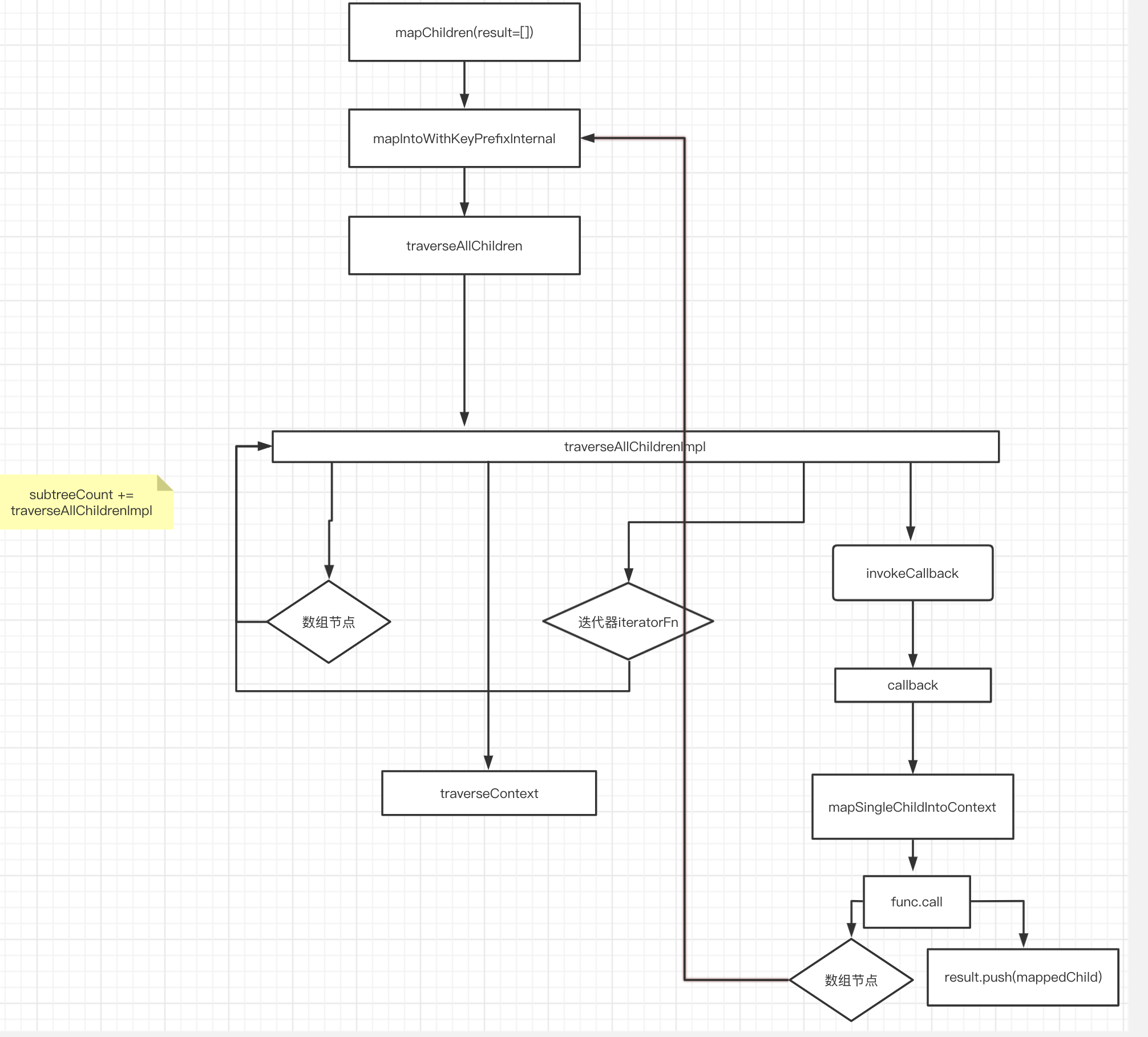
上来对传来的 children 做了检测, 如果是 数组 或者 迭代器 就继续递归自己, traverseContext 里面包含着以下属性
  result: mapResult,
  keyPrefix: keyPrefix,
  func: mapFunction,
  context: mapContext,
  count: 0,
重点是 invokeCallback 为 true 的时候 执行 callback, 也就是传入的 mapSingleChildIntoContext 方法
function mapSingleChildIntoContext(bookKeeping, child, childKey) {
  const { result, keyPrefix, func, context } = bookKeeping;
  // func 就是我们在 React.Children.map(this.props.children, c => c)中传入的第二个函数参数
  let mappedChild = func.call(context, child, bookKeeping.count++);
  if (Array.isArray(mappedChild)) {
    // 数组递归展平
    // React.Children.map(this.props.children, c => [c, [c, [c]]])
    mapIntoWithKeyPrefixInternal(mappedChild, result, childKey, (c) => c);
  } else if (mappedChild != null) {
    if (isValidElement(mappedChild)) {
      // 创建一个新的ReactElement
      mappedChild = cloneAndReplaceKey(
        mappedChild,
        // Keep both the (mapped) and old keys if they differ, just as
        // traverseAllChildren used to do for objects as children
        keyPrefix +
          (mappedChild.key && (!child || child.key !== mappedChild.key)
            ? escapeUserProvidedKey(mappedChild.key) + "/"
            : "") +
          childKey,
      );
    }
    result.push(mappedChild);
  }
}
2
3
4
5
6
7
8
9
10
11
12
13
14
15
16
17
18
19
20
21
22
23
24
25
我们在 React.Children.map(this.props.children, fun => fun) fun 执行完如果还是一个 数组 则继续 去 又跑去调用 mapIntoWithKeyPrefixInternal。
这个时候我们再回去看,每次从 pool 里面取 context 了,而 pool 的意义大概也就是在这里了,如果循环嵌套多了,可以减少很多对象创建和 gc 的损耗。
频繁的对象创建,频繁的垃圾回收让 GC 没有机会工作
# 验证
看完上面的流程,个人做了自己的理解,就是把一个多维数组,铺平成一个一维数组,按照深度优先的规则.下面来验证下自己的这个总结是否正确,
我们在看看 ReactChildren-test.js 文件下面的测试用例,如 219 行的一个 🌰 来说
  it('should be called for each child in nested structure', () => {
    const zero = <div key="keyZero" />;
    const one = null;
    const two = <div key="keyTwo" />;
    const three = null;
    const four = <div key="keyFour" />;
    const five = <div key="keyFive" />;

    const context = {};
    const callback = jest.fn().mockImplementation(function(kid) {
      return kid;
    });

    const instance = <div>{[[zero, one, two], [three, four], five]}</div>;

    function assertCalls() {
      expect(callback).toHaveBeenCalledTimes(6);
      expect(callback).toHaveBeenCalledWith(zero, 0);
      expect(callback).toHaveBeenCalledWith(one, 1);
      expect(callback).toHaveBeenCalledWith(two, 2);
      expect(callback).toHaveBeenCalledWith(three, 3);
      expect(callback).toHaveBeenCalledWith(four, 4);
      expect(callback).toHaveBeenCalledWith(five, 5);
      callback.mockClear();
    }

    React.Children.forEach(instance.props.children, callback, context);
    assertCalls();

    const mappedChildren = React.Children.map(
      instance.props.children,
      callback,
      context,
    );
    assertCalls();
}
2
3
4
5
6
7
8
9
10
11
12
13
14
15
16
17
18
19
20
21
22
23
24
25
26
27
28
29
30
31
32
33
34
35
36
我们自己再写个简单 demo 验证下
const arr = [["1", "2"], ["3"], ["4", ["1", "1"]]];

function ReactChindren() {
  return Children.map(arr, (child, index) => {
    return <li>{child}</li>;
  });
}

export default ReactChindren;
2
3
4
5
6
7
8
9
按照上面总结,应该依此排列的为 1,2,3,4,1,1, 我们访问页面发现也是正确的
# 总结
使用 React.Children 可以更好的保护我们的程序,我们可以用来替换常规的 map 方法. 它可以把一个多维数组(或者嵌套的 Element)铺平成一个一维数组,按照深度优先遍历的规则,最后再渲染我们的 child,但是 传入的 child 不能是一个 object 对象. 最后用一张图做了简单总结
← JSX React-Fiber →